Meta description: Learn why smart decision-making often beats raw talent in youth baseball (8–14). Get practical coaching cues, game-awareness drills, hitting IQ examples, and parent-friendly ways to build situational baseball.
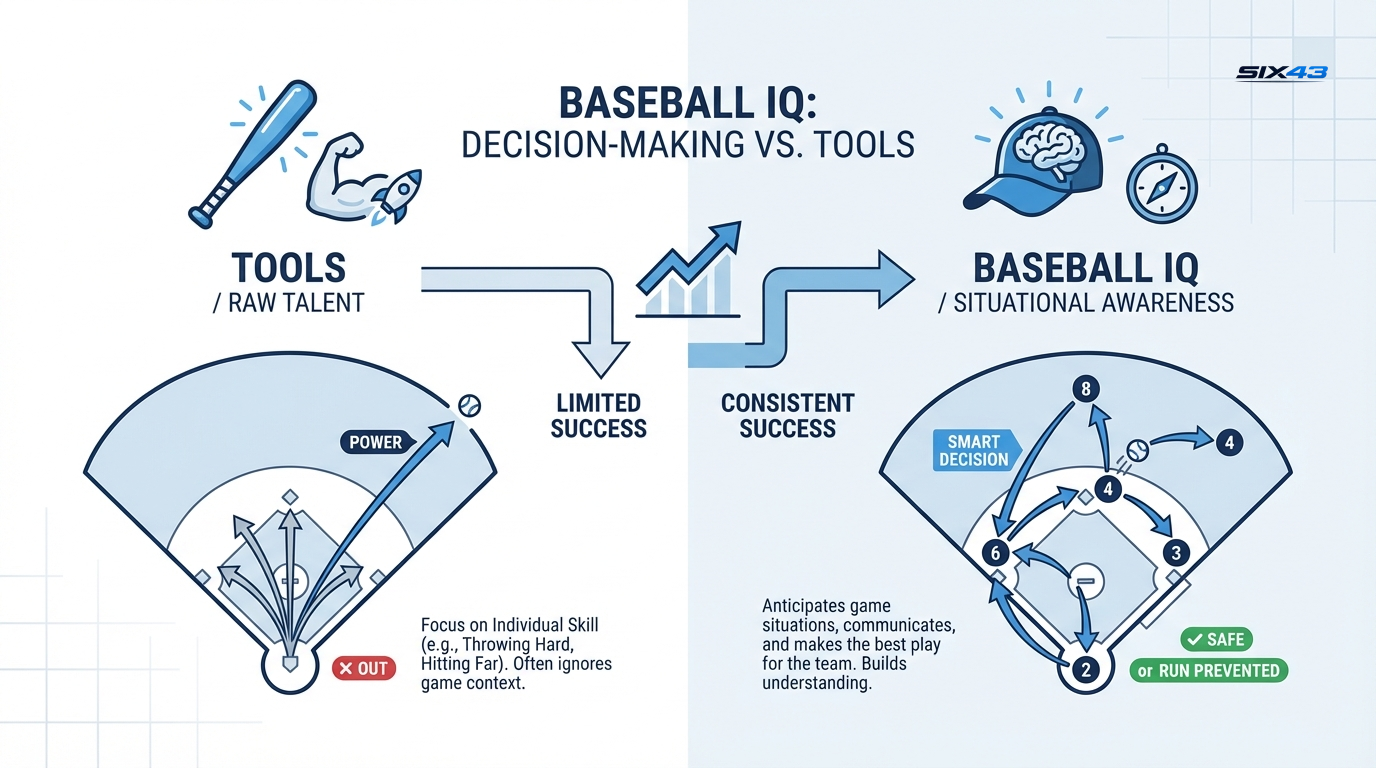
When coaches talk about baseball IQ, we’re talking about a kid’s ability to think the game.
Not in a “chalk talk” way. In a “can you handle the next 3 seconds?” way.
In youth terms, baseball IQ is:
That’s what people mean when they say a player “just knows how to play.” It’s situational baseball, applied in real time.
Before every pitch, a high-IQ youth player is tracking:
No advanced analytics required. Just clean thinking.
From what I’ve seen coaching this age group, a lot of 8–14 games aren’t “won” by one kid being unstoppable. They’re lost in the margins:
That’s why an average-tools player with strong game awareness can look like a difference-maker. They don’t leak outs. They calm the inning down.
A coaching way to say it (not a math equation):
And at youth levels, stopping the “free” chaos runs is a real competitive advantage.
I’ll never forget a kid I coached who wasn’t our fastest runner—middle of the pack, honestly.
But he led the team in runs.
Why?
Meanwhile, we had a burner who stole second easily… and then gave it back with a sleepy lead or a bad read.
That’s baseball IQ in youth baseball: not flashy, just productive.
Good youth defense isn’t about making SportsCenter plays. It’s about being in the right place early.
If your team backs up consistently, you’ll watch opponents stop taking extra bases.
Coaching cue: “Every throw has a backup. Every time.”
A cutoff (also called a cut) is the fielder who lines up between the outfielder and the target base to help:
Youth version of cuts and relays:
The quickest way to spot a high-IQ infield is simple: bags aren’t left unattended, and you don’t see three players racing to the same spot.
Kids don’t need 12 different coverage rules. They need a few clear ones that show up every game:
Positioning is just where you start before the pitch.
Youth positioning doesn’t need to be complicated. Small moves are enough:
Coaching cue: “Win the first step.” If the first step is right, the rest looks athletic.
This is where “smart baseball plays for kids” show up fast.
Tagging up means keeping contact with the base until a fly ball is caught—then running.
The IQ part isn’t knowing the rule. It’s knowing:
One correct tag can win a game at this age.
Youth baseball has a lot of “I’m going to be the hero” decisions.
A high-IQ runner can still be aggressive—but picks better spots:
Coaching cue: “Pressure them, don’t rescue them.” If the defense is already making mistakes, your job is to stay on the bases.
“Always take two!” sounds tough… until you watch a kid run into a routine out.
Teach reads, not slogans:
Most baseball IQ talks lean defense-heavy. But hitting IQ is a real separator in youth baseball—especially because pitchers at this age are still learning control.
Hitting IQ is having an approach that fits the situation, not just swinging hard.
With two strikes, the goal shifts:
For youth players, this can be as simple as:
A lot of youth hitters pull everything because they’re early.
A smart cue that works:
That’s not fancy. It’s teaching a kid to make a decision based on information.
A productive out is an out that still helps your team—like moving a runner from second to third.
At 8–14, you won’t get this perfectly every time. But you can teach the concept:
Coach language I like: “Give us a chance.” Put the ball in play and force the defense to handle it.
“Hitting behind the runner” means you try to hit the ball to the side of the infield that helps the runner advance—often the right side when there’s a runner on second.
At youth levels, keep it simple:
Even if it’s just a ground ball to the right side, that’s often a winning baseball play.
At youth ages, the loudest team isn’t always the best.
But the teams that communicate early and clearly? They usually give away fewer outs.
Baseball IQ includes:
Coaching cue: “Early, loud, and specific.” (Not just noise.)
If you want better baseball IQ, you don’t need longer speeches.
You need better reps and a little bit of guided thinking.
These are my go-to youth baseball game awareness drills and habits.
In a scrimmage or team defense:
Good questions:
Instead of endless ground balls with no runners, create game pictures:
Kids learn faster when reps match reality.
If a kid makes the right read and the throw isn’t strong enough yet, that’s still progress.
Reward:
That’s how you keep players thinking instead of playing scared.
“Lineup construction” just means how you order hitters to give the team the best chance to score.
At youth levels, don’t fall in love with “biggest kid hits third.” Often, your best lineup is built around:
A smart decision-maker who gets on base and takes the right extra 90 feet is a lineup weapon—even if they’re not the strongest kid.
If you teach one baseball IQ skill that scales from 9U to high school, make it this.
Before every pitch, the player quietly answers three questions:
That’s it. Three seconds.
But it works because it turns “awareness” into a repeatable routine. As the game speeds up, their mind is already ahead of the play.
You don’t need to be a former player to help your kid’s baseball IQ. You just need to watch the game a little differently.
Pick one defensive inning and ask your kid (before the pitch):
Keep it light. This isn’t an interrogation—think of it like playing catch with their brain.
Instead of “Did you get a hit?” try:
That builds reflection—one of the fastest paths to game awareness.
If you watch any baseball together, pause once or twice and ask:
You’re training pattern recognition, not memorizing rules.
The best thing a parent can do is help a kid become the driver.
Try: “What’s your pre-pitch plan here?”
When they start answering without you asking, you’ll see it show up on the field.
Internal links note: If your site has deeper articles on cuts and relays, baserunning reads, or youth lineup strategy, link those phrases naturally in the relevant sections above.